The stone type used in a retaining wall affects not only how the wall looks but how it performs over decades of freeze-thaw cycling, moisture exposure, and lateral soil pressure. Canada's climate imposes specific demands: materials that are adequate in temperate regions can spall, crack, or degrade prematurely when subjected to the repeated freeze-thaw cycles common across most of the country.
This article compares the primary stone types used in Canadian retaining wall construction and notes where each is commonly available and where it tends to perform well.
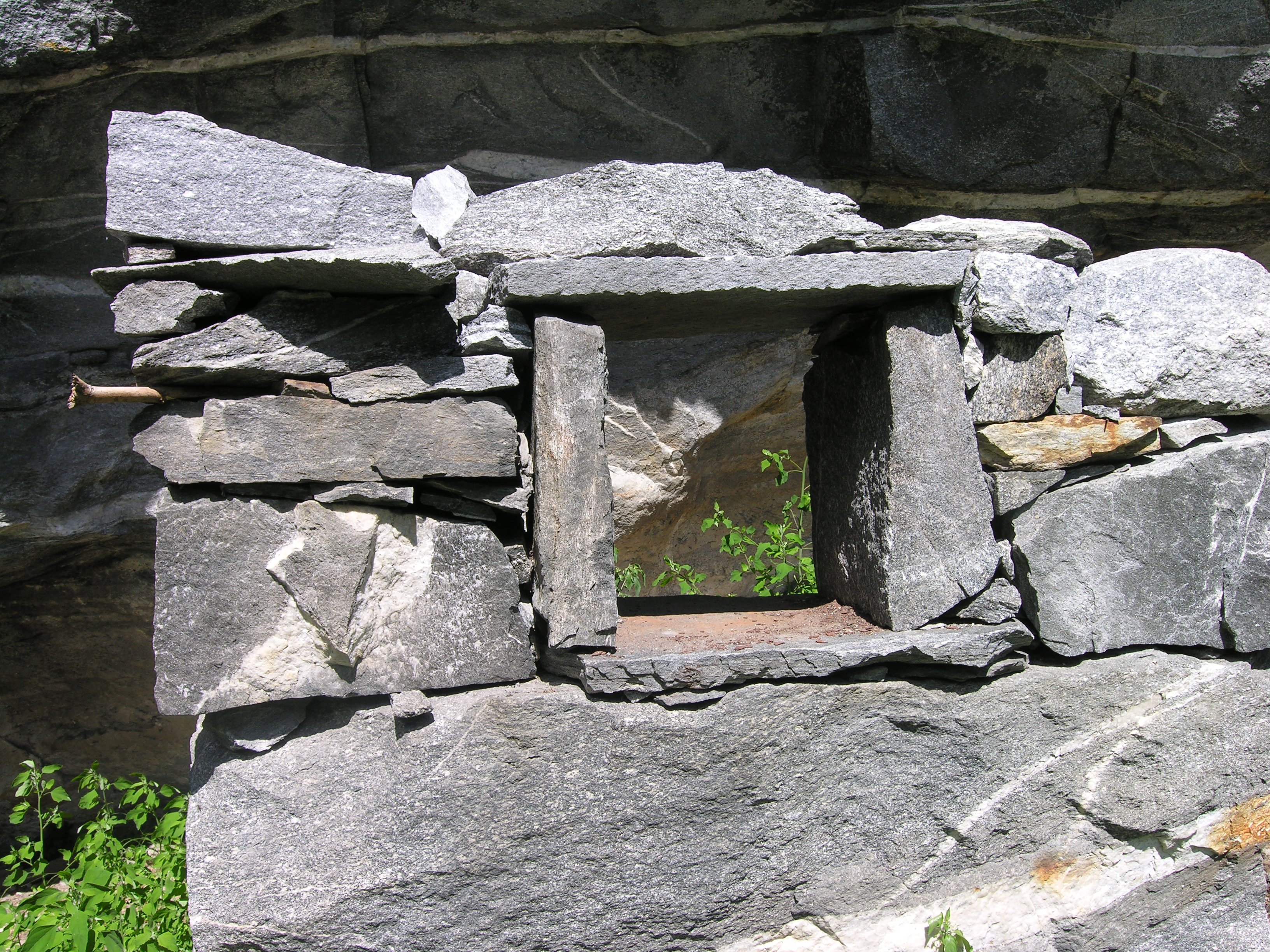
A dry stone wall with a window opening, showing the tight stone fitting characteristic of durable dry-stack construction. Photo: Audrius Meskauskas, CC BY-SA 3.0 via Wikimedia Commons.
Key Properties to Evaluate
Before selecting a material, the following properties determine its suitability for Canadian retaining wall applications:
- Freeze-thaw resistance — the stone's ability to withstand repeated cycles of water freezing in pores and joints
- Compressive strength — relevant for base courses and walls with significant surcharge loads
- Workability — how easily the stone can be split, dressed, or stacked to form stable courses
- Absorption rate — high-absorption stones trap more water and are more susceptible to spalling
- Regional availability — transport cost increases significantly when stone must be shipped long distances
Fieldstone (Glacial Erratic)
Fieldstone refers to naturally occurring stones collected from fields, riverbeds, or glacial deposits. Across Ontario, Quebec, and the Maritime provinces, glacial activity left extensive deposits of mixed granite, gneiss, and quartzite boulders. These are commonly used in traditional dry-stack walls.
Workability consideration: Fieldstone is rarely uniform. Rounded river cobbles have limited contact surfaces between stones and are not suitable as the primary structural material in a gravity wall. Angular glacial stones with flatter faces are preferable.
| Stone Type | Freeze-Thaw Resistance | Workability | Common Availability |
|---|---|---|---|
| Glacial fieldstone (granite/gneiss) | High | Moderate — irregular shapes require selection | ON, QC, Atlantic provinces |
| Limestone (dense) | Moderate–High | Good — splits along bedding planes | ON, MB, AB |
| Granite (quarried) | Very High | Difficult without equipment | BC, ON, QC |
| Sandstone | Variable — depends on density | Good — cuts easily | AB, SK, BC interior |
| Basalt | Very High | Difficult — very hard | BC (volcanic regions) |
Limestone
Dense limestone is one of the most widely used stone types for mortared retaining walls in Ontario and Manitoba. It splits relatively cleanly along natural bedding planes, making it easier to produce consistently flat faces. Southern Ontario has extensive limestone deposits, and the material is common in heritage stone walls across the region.
However, not all limestone is equivalent. Softer, more porous varieties — sometimes called "soft limestone" or "lace limestone" — absorb water readily and are susceptible to frost spalling. When selecting limestone, confirm the specific absorption rate with the supplier and choose dense, well-cemented varieties for structural applications.
Granite
Quarried granite is among the most durable options available. Its very low absorption rate (typically under 0.4%) makes it highly resistant to frost damage. Crushed granite aggregate is also commonly used as the drainage layer behind retaining walls due to its permeability and angular particle shape.
The difficulty with granite is workability: it requires diamond-tipped tools to cut and is challenging to dress without equipment. For residential dry-stack applications, granite is more often used as-is (split face) rather than dressed.

A finished natural stone retaining wall showing the irregular coursing typical of field-assembled stone. Photo: Retainingwallexperts, CC BY-SA 4.0 via Wikimedia Commons.
Sandstone
Sandstone is available in parts of Alberta, Saskatchewan, and the BC interior. It cuts well and can produce attractive walls with a warm color range. Quality varies significantly between deposits. Dense, silica-cemented sandstone performs adequately in most Canadian climates; calcareous-cemented varieties are weaker and more moisture-sensitive.
For outdoor structural applications in cold climates, always request freeze-thaw test data from the quarry supplier. The ASTM C170 compressive strength test and the ASTM C99 modulus of rupture test are standard benchmarks for evaluating dimension stone performance.
Concrete Block (Segmental Retaining Wall Units)
Segmental concrete retaining wall (SRW) blocks — marketed under names such as Unilock, Permacon, or Anchor Block depending on the region — offer dimensional consistency and straightforward installation. They are manufactured to specific tolerances and tested for freeze-thaw durability.
For natural stone aesthetics at lower cost, concrete block is a common choice on new residential construction. However, the visual character differs from natural stone, and some heritage neighbourhoods have design guidelines restricting their use.
Geogrid Reinforcement with SRW Block
When SRW blocks are used for walls over approximately 1.0 m in retained height, they are typically combined with geogrid reinforcement layers embedded in the compacted backfill. The geogrid extends the wall's effective base, converting it from a gravity structure to a reinforced soil structure. This is specified by the block manufacturer and requires compliance with their published design tables.
Sourcing Notes by Province
- Ontario: Limestone widely available from Marmora, Kingston area, and southern Georgian Bay. Granite from the Canadian Shield zone north of the Great Lakes.
- British Columbia: Granite and basalt in the lower mainland and Vancouver Island. Sandstone in the Okanagan interior.
- Alberta: Sandstone historically quarried near Calgary (Paskapoo Formation). Limestone in the foothills region.
- Manitoba: Tyndall Stone (a distinctive mottled limestone) quarried near Garson — used extensively in heritage buildings in Winnipeg.
- Quebec: Laurentian granite and regional fieldstone widely available. Dimension stone from the Eastern Townships region.
References: Natural Resources Canada — Minerals and Metals Facts; ASTM International — C170, C99 dimension stone standards.